

Our services › Screen printing
Screen printing in Luxembourg
Screen printing is the ideal textile printing method for bulk orders: vivid colours that survive washing, at a price that drops as quantities go up.
T-shirts, hoodies, tote bags, event clothing… We screen print your logos and designs in our workshop in Holzem. Ideal for kitting out a team, an event or a marketing campaign.
What is screen printing?
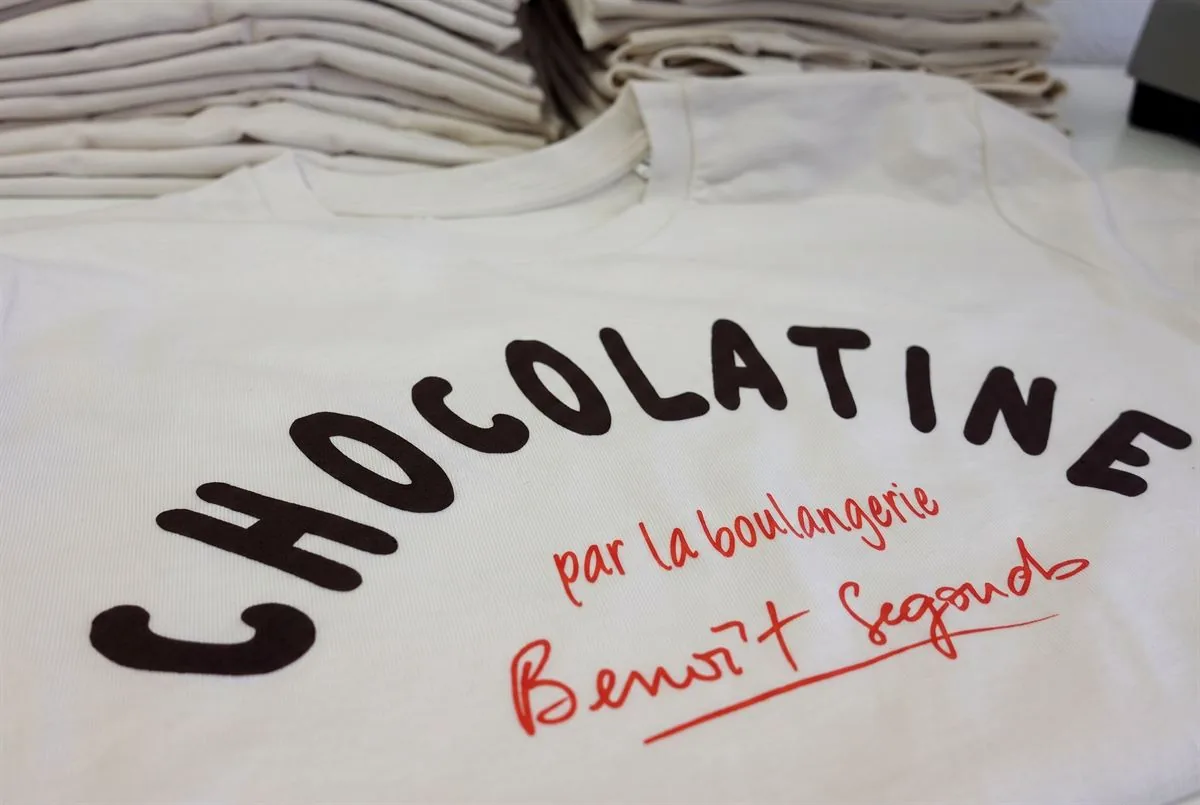
Screen printing (also called silk screen printing or serigraph printing) applies ink to fabric through a screen: a fine mesh stretched over a frame, where only the shape of the design lets the ink through. The term "serigraphy" comes from the Latin sericum (silk, the material of the first screens) and the Greek graphein (to write).
Each colour in the design has its own screen and is printed one after the other. The ink is then cured at high temperature: it bonds with the fibre, which gives screen printing its excellent wash resistance.
Screen printing for businesses, events and associations
As soon as quantities increase, screen printing becomes the most cost-effective technique. It is the ideal choice for event t-shirts, races and festivals, promotional textiles and branded tote bags, workwear or your club's t-shirts.
Screen printed t-shirts, hoodies and tote bags
Screen printing works on most cotton and cotton-blend textiles. These are the items we screen print most often:
Did you know? On dark fabrics, we first print a white underbase: your colours stay as bright as on a white t-shirt.
How does screen printing work?
- Your requestSend us your design, the items you need, the colours and the quantities.
- PreparationWe separate the colours of your design and send you a proof to approve.
- Screens and printingOne screen is made per colour, then each colour is printed one after the other.
- Curing and deliveryThe ink is cured at high temperature, then your items are delivered or ready for collection.
Screen printing prices: what affects the cost
The price of screen printing mainly depends on the preparation (the screens) and the quantity. These are the factors that count:
| Factor | Effect on price |
|---|---|
| Number of colours | The main factor: each colour needs its own screen and a separate print run. |
| Quantity | The screens are spread over the whole order: the larger the quantity, the lower the price per item. |
| Number of positions | Each printed position (chest, back, sleeve…) is priced separately. |
| Fabric colour | On dark fabrics, a white underbase is needed. |
| Chosen item | The price of the garment or bag is added, depending on the model and brand. |
Tip: keeping your design to 1 or 2 colours greatly reduces the price. For very small quantities or photo designs, we will recommend DTF transfers or digital printing.
Recommended screen printing sizes and positions
Here are the most common sizes. We adapt them to your design and the chosen item.
| Position | Recommended size | Ideal for |
|---|---|---|
| Left chest | 8 to 10 cm wide | Company logo, workwear |
| Front (large) | 25 to 30 cm wide | Event t-shirts, campaign designs |
| Back | 25 to 30 cm wide | Team names, sponsors, tour dates |
| Sleeve | 6 to 9 cm wide | Website, slogan, flag |
| Tote bag | 20 to 30 cm wide | Trade fairs, shops, customer gifts |
Advantages and limits of screen printing
Advantages
- Vivid, bold colours true to the Pantone colour chart
- Very good wash resistance, the ink bonds with the fibre
- The lowest price per item on medium and large runs
- Perfect results on both light and dark fabrics
Limits
- Not cost-effective for a single item or very small quantities
- Each extra colour increases the price
- Very fine details and photos are harder to reproduce
- Longer preparation time than digital printing
Screen printing, DTF transfer or digital printing: which to choose?
| Screen printing | DTF transfer | Digital printing | |
|---|---|---|---|
| Ideal quantity | Medium and large runs | From one item | From one item |
| Number of colours | Limited, one colour per screen | Unlimited | Unlimited |
| Photos and gradients | Less suitable | Yes | Yes |
| Durability | Very good | Very good | Good |
| Price in large quantities | € | €€ | €€ |
Screen printing on black or dark t-shirts
Screen printing works just as well on dark fabrics as on light ones. On a black, navy or burgundy t-shirt, we first print a white underbase, then your colours on top: they keep all their brightness.
This underbase counts as an extra colour in the quote.
Which file to send for screen printing?
Ideally, a vector file (AI, EPS, SVG or vector PDF), with your colours as Pantone references if you have them. Otherwise, a high-resolution PNG will do: we prepare your design for printing if needed.
Everything about screen printing
What is screen printing?
Screen printing is a printing technique that applies ink to fabric through a screen, a fine mesh where only the shape of the design lets the ink through. Each colour has its own screen. The ink is then cured at high temperature to bond with the fibre.
How much does screen printing cost?
The price mainly depends on the number of colours in your design, the quantity and the number of positions. The screens are spread over the whole order: the more items you order, the lower the price per piece. Ask us for a quote: it is tailored to your project.
From what quantity is screen printing worth it?
Screen printing becomes worthwhile from medium runs, and the most cost-effective option for large quantities. For just a few items, DTF transfers or digital printing are often better suited: we will advise you on the best option.
Can you screen print on a black t-shirt?
Yes. On dark fabrics, we print a white underbase before your colours, so they stay bright.
How many colours can be screen printed?
Several colours are possible, each printed with its own screen. Each extra colour increases the price: for a very colourful design or a photo, digital printing or a DTF transfer is often a better fit.
Is screen printing washable?
Yes, very much so: the ink bonds with the fibre of the fabric. Wash the garment inside out at 30 or 40 °C and iron it inside out to keep the colours bright for a long time.
Which file should I send for screen printing?
A vector file (AI, EPS, SVG, PDF) is ideal, with your Pantone colours if you know them. A high-resolution PNG can also work: we prepare your design if needed.
How long does a screen printing order take?
Allow 5 to 10 working days after approval of your proof, depending on the quantity. If you need your items by a specific date (event, race, trade fair), please mention it in your quote request.
What is the difference between screen printing and screen printed transfers?
With direct screen printing, the ink is printed straight onto the fabric. With screen printed transfers, the design is first printed on special paper, then heat-applied to the fabric: a practical solution for small logos and items that are hard to print directly.