

Bamboo Tableware: Beware of Melamine and How to Choose Safely
Mugs, plates, bowls, lunch boxes, cutlery: bamboo tableware has become the "natural" alternative to disposable plastic. Light, colourful, presented as eco-friendly… it has everything going for it. But beware: much of this tableware is not made of bamboo alone. It often contains melamine, a plastic resin that can release unwanted substances into food. In this guide, we explain the difference between bamboo and "bamboo fibre", what the regulations say, how to recognise the products to avoid and which alternatives to choose for eating on the go with peace of mind.
In this guide:
- Why bamboo tableware is everywhere
- Bamboo or bamboo fibre: what is the difference?
- The problem with melamine
- What the regulations say
- How to recognise melamine bamboo tableware
- Already own bamboo fibre tableware: what should you do?
- The real alternatives
- Is solid bamboo really eco-friendly?
- Eating on the go without plastic: good habits
- Using and caring for solid bamboo
- Bamboo and stainless steel items to personalise
- Frequently asked questions
Why bamboo tableware is everywhere
For several years, Europe has been turning the page on disposable plastic. Since July 2021, the European directive on single-use plastics has banned many disposable plastic items from the market: cutlery, plates, straws, stirrers, balloon sticks, and expanded polystyrene food containers and cups. In France, the anti-waste law for a circular economy goes even further and plans to phase out all single-use plastic packaging by 2040.
To replace these items, many reusable products have appeared. Among them, bamboo tableware has been a huge success: travel mugs, cups, children's plates, lunch boxes, cutlery… It seemed to tick every box: natural, light, sturdy and cheap. The problem is that a large share of these products is not as natural as it looks.
Bamboo or bamboo fibre: what is the difference?
Bamboo is a very fast-growing plant: some species can grow almost a metre in a single day. It grows without irrigation or pesticides, making it an interesting renewable resource. But everything depends on how it is used.
Solid bamboo
Solid bamboo is used as it is, like wood: it is cut, sanded, sometimes assembled and oiled. Its fibrous structure and nodes are easy to recognise. Cutlery, chopping boards, chopsticks, lunch box lids or toothbrushes in solid bamboo are natural and durable items, provided they are well cared for.
"Bamboo fibre", a blend
Bamboo fibre tableware, on the other hand, is made from bamboo powder or fibres mixed with a resin, usually melamine-formaldehyde, then pressure-moulded. The result looks and feels like plastic: smooth, uniform, often coloured or decorated. Behind its natural look, it is actually a composite material, partly plastic, that is neither compostable nor recyclable.
The same trap exists in textiles: most "bamboo" garments are actually bamboo viscose, which is chemically processed. We explain this in our textile fabrics guide.
The problem with melamine
Melamine is a hard plastic resin that has long been used for tableware. It is not toxic in itself at room temperature. The problem arises when it is heated or comes into contact with acidic foods: it can then break down and release melamine and formaldehyde, two substances that can migrate into food and drinks.
The German Federal Institute for Risk Assessment (BfR) raised the alarm on this subject after analysing bamboo fibre tableware. Its work showed that with very hot liquids (from about 70 °C), a significant share of the cups tested released amounts of melamine and formaldehyde above the European limits, all the more so the more often the cup was used. Formaldehyde is classified as carcinogenic, and melamine can damage the kidneys at high exposure.
In practice, pouring a scalding coffee into a bamboo fibre mug, reheating a meal in the microwave in such a lunch box or storing tomato sauce in it is not harmless. Children, who are more sensitive, are particularly concerned by the colourful plates and cups made for them.
What the regulations say
Faced with these risks, the European Union has clarified the rules. The additives authorised in plastics intended for food contact are strictly listed, and bamboo powder or fibres are not among them. Since 2021, European authorities therefore consider plastic items containing bamboo or other plant fibres as non-compliant for food contact, and they are subject to checks and market withdrawals.
Despite this, these products can still sometimes be found online, on international platforms or under vague names such as "natural bamboo", "eco" or "biodegradable". Hence the importance of knowing how to recognise them.
How to recognise melamine bamboo tableware
A few simple clues will help you tell the difference:
- The look: solid bamboo clearly shows its fibrous, wood-like structure. Melamine tableware looks smooth and uniform, like plastic, with no grain.
- Colours and patterns: bright colours, printed patterns or highly moulded shapes often give away a composite.
- The composition: be wary of words such as "bamboo fibre", "melamine", "MF" or "composite". A 100% bamboo product says so clearly.
- Usage symbols: a solid bamboo item generally cannot go in the dishwasher or microwave, so those symbols are crossed out. A "bamboo" item presented as compatible with everything should raise suspicion.
- The price: a "bamboo" mug or complete set at a very low price often hides a blend.
If in doubt, take no risks: do not use the item for hot or acidic food, and choose other materials.
Already own bamboo fibre tableware: what should you do?
No need to panic, but take a few precautions. If you own bamboo fibre mugs, cups or plates, stop using them for hot drinks or food, or for acidic foods such as citrus fruit, tomatoes or vinegar, and never put them in the microwave. You can reserve them for uses without food contact: storing small items, a pencil pot, a plant holder. When they are damaged, scratched or discoloured, throw them away with household waste: they are neither recyclable nor compostable. And to replace them, turn to stainless steel, glass, ceramic or solid bamboo.
The real alternatives
To eat on the go without plastic or melamine, several materials have proven themselves:
| Material | Strengths | Points to watch |
|---|---|---|
| Solid bamboo | natural, light, renewable | hand wash, oil from time to time |
| Stainless steel | unbreakable, very durable, does not retain odours | not microwave-safe |
| Glass | healthy, transparent, microwave and oven-safe | heavier, fragile |
| Porcelain, ceramic | healthy, durable, pleasant | heavy, fragile, not very portable |
| Wood | natural, warm | hand wash, oil regularly |
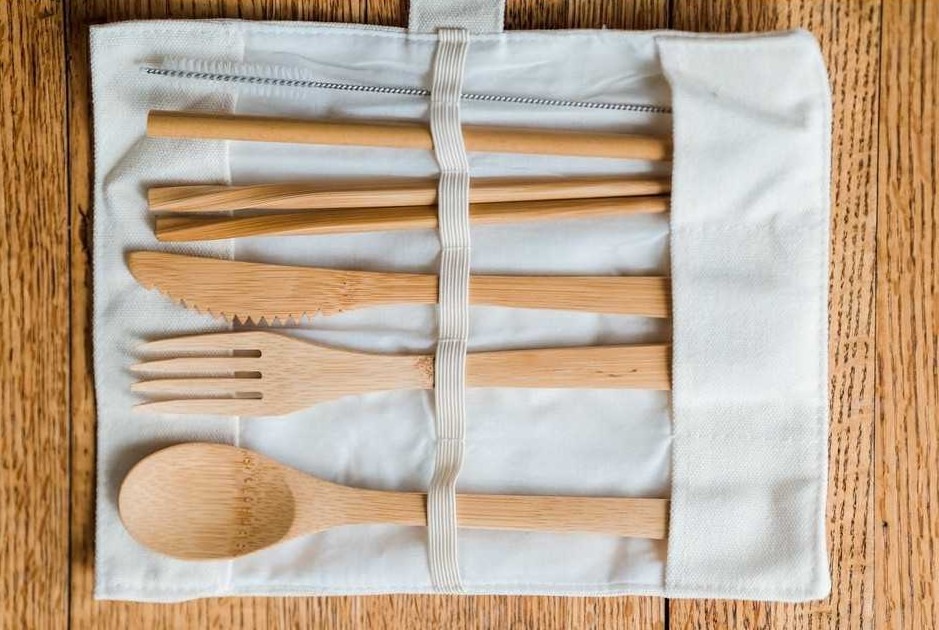
Combinations are often the most practical: a stainless steel lunch box with a solid bamboo lid, an insulated stainless steel bottle, or solid bamboo cutlery slipped into a cotton pouch. You get the lightness of bamboo and the strength of stainless steel, with no plastic touching your food.
Is solid bamboo really eco-friendly?
Solid bamboo has real advantages: it grows very fast, regenerates without replanting, needs little water and no pesticides, and stores carbon as it grows. Used as it is, it makes light, strong items that are biodegradable at the end of their life.
As always, though, you need to look at the whole life cycle. Most bamboo comes from Asia, which means long transport. Some items are also treated, glued or varnished. Good habits: choose solid bamboo items that are unvarnished or oiled with a food-grade oil, from sustainably managed forests (the FSC label is a good indicator), and above all choose items you will use for a long time. A reusable item is only truly green if it replaces dozens of disposable ones.
Eating on the go without plastic: good habits
At the office, at school, travelling or on a picnic, a few items are enough to do without disposables:
- An insulated stainless steel bottle for water, coffee or tea, hot or cold, all day long.
- A stainless steel lunch box, possibly with a solid bamboo lid, for your meals.
- Reusable cutlery in solid bamboo or stainless steel, in a cotton pouch.
- A reusable mug in stainless steel, glass or ceramic for takeaway coffee.
- A cotton tote bag to carry everything, in our custom bags.
Personalised with a name or a logo, these items get lost less, borrowed less… and make lovely gifts.
Using and caring for solid bamboo
Solid bamboo is a natural material: a few precautions are enough to keep it looking good for a long time.
- Wash it by hand in hot soapy water, and avoid the dishwasher, which dries it out and makes it split.
- Dry it straight away and do not leave it to soak.
- Oil it from time to time with a food-grade oil (linseed or olive) to nourish it.
- Avoid the microwave and extreme temperatures.
- Replace it if it splits or is badly damaged.
Bamboo and stainless steel items to personalise
At Zigzag-Concept, we have selected a range of more responsible everyday items to personalise with a name, a text or your logo: bamboo cutlery with its cotton pouch, steel and bamboo lunch boxes, reusable insulated bottles and mugs, and canvas bags. Discover them in our mugs, bottles and lunch boxes and our personalised items.
These useful items also make excellent eco-friendly corporate gifts: they are used every day and keep your brand visible for a long time. We also put together custom gift boxes to suit your budget and your values, in our gifts and gift boxes. And to go further in a responsible approach, read our guide to eco-friendly custom t-shirts.
A project for gifts or personalised items? Request your quote, we will get back to you quickly.
Frequently asked questions
Is bamboo tableware dangerous?
Solid bamboo tableware is not a problem. The risk concerns "bamboo fibre" tableware mixed with melamine: when heated or in contact with acidic food, it can release melamine and formaldehyde into food.
How can I tell if my bamboo tableware contains melamine?
A smooth, plastic-like look, bright colours, printed patterns and words such as "bamboo fibre", "melamine" or "composite" are clues. Solid bamboo, on the other hand, shows its fibrous structure.
Is bamboo fibre tableware banned?
In the European Union, plastics containing bamboo or other plant fibres are not authorised for food contact, and these products have been subject to market withdrawals since 2021.
Can bamboo tableware go in the microwave?
No. Solid bamboo may split, and bamboo fibre tableware can release unwanted substances when heated. To reheat food, use glass or ceramic instead.
What is the best alternative for a lunch box?
A stainless steel lunch box, possibly with a solid bamboo lid, is strong, durable and plastic-free where it touches food. Glass is ideal if you reheat your meal in the microwave.
Is bamboo cutlery a good idea?
Yes, if it is solid bamboo. Light and reusable, it is a perfect replacement for disposable cutlery, especially stored in a cotton pouch so you can take it everywhere.
Is a bamboo toothbrush a good alternative?
Yes, if the handle is solid bamboo. It is a simple alternative to a plastic toothbrush: only the bristles, often nylon, need to be removed before composting or throwing away the handle.